
Real-World Problem: The 2:14 AM Internal Cascade
The pager shrieked at 2:14 AM. Our checkout and payment microservices were dropping 42% of inbound requests. Node memory spiked from a calm 3.2 GB to a critical 15.8 GB on our 16 GB Kubernetes workers, and p99 latency rocketed from 14 milliseconds to 6.2 seconds. Cloudflare and edge ingress gateways reported completely normal traffic patterns—roughly 1,200 requests per second. Yet inside the cluster, internal pods were choking.
We had fallen into a classic architectural trap: treating the VPC boundary as an absolute security perimeter. Because our services sat behind an edge reverse proxy, we ran all internal gRPC listeners using grpc.insecure_server_credentials(). When an engineer’s compromised staging container gained network reachability into production, the attacker didn’t need to break encryption. The pod simply started blasting unauthenticated remote procedure calls straight into our core backend services.
Root Cause Analysis: Where Plain gRPC Fails
Default gRPC configurations favor developer convenience over defensive isolation. In our post-incident autopsy, three architectural gaps surfaced immediately:
- Cleartext Insecure Credentials: Services started with
grpc.insecure_server_credentials(). Any workload sharing the cluster subnet could issue RPCs to any exposed protobuf method without exchanging a single cryptographic identity. - Perimeter-Only Authorization: Edge gateways stripped and validated external JWTs, but internal gRPC handlers assumed every incoming HTTP/2 frame was safe. Sensitive methods—including
TransferFundsandUpdateAccountRole—ran without checking which pod originated the call. - Unbounded Resource Consumption: gRPC servers do not limit concurrent HTTP/2 streams or keepalive ping abuse out of the box. The attacker opened 18,000 persistent streaming channels sending fragmented payloads, which exhausted worker thread pools and triggered Linux OOM-killer runs across four cluster nodes.
Architecture Comparison: Securing Inter-Service Traffic
Mitigating these vulnerabilities requires trade-offs between implementation effort, runtime overhead, and defensive depth:
Option 1: Kubernetes NetworkPolicies
Restricting IP CIDRs with Calico or Cilium stops rogue pods from opening raw TCP sockets across namespaces. This provides good baseline hygiene. However, network policies cannot encrypt data in transit, do not stop packet inspection on shared worker nodes, and cannot verify application identities.
Option 2: Bearer Tokens in gRPC Metadata
Injecting shared tokens into gRPC call metadata (headers) allows handlers to identify callers. But passing static secrets across plaintext HTTP/2 invites disaster. Any engineer running tcpdump on a node interface or inspecting sidecar logs can capture the token and replay requests indefinitely.
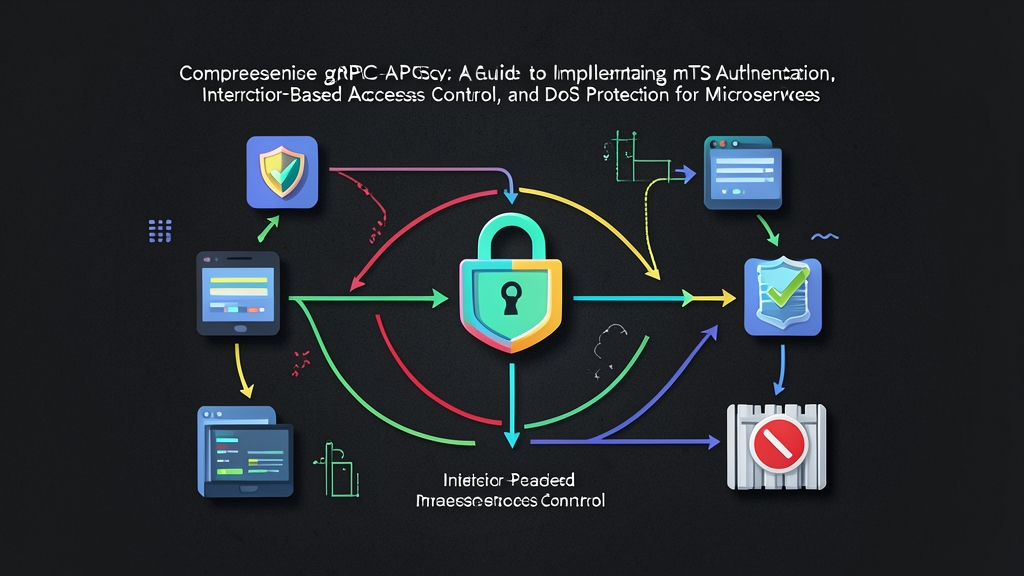
Option 3: Defense-in-Depth (mTLS + Method Interceptors + Channel Limits)
This approach combines cryptographic transport security with granular access control. Mutual TLS (mTLS) proves pod identities bi-directionally using X.509 certificates. Interceptors enforce role permissions at the RPC boundary, and channel-level limits reject stream floods before payloads hit memory.
Step-by-Step Implementation: The Hardened Python gRPC Stack
Here is the production implementation we rolled out to contain the breach and secure all service-to-service communication.
Step 1: Generate Internal CA and Certificates with SAN
Modern TLS implementations reject certificates that lack Subject Alternative Names (SAN). Run the following commands to create a private Certificate Authority and issue SAN-validated certificates for both caller and receiver:
# 1. Generate Private Root CA (valid for 1 year)
openssl req -x509 -newkey rsa:4096 -days 365 -nodes \
  -keyout ca-key.pem -out ca-cert.pem \
  -subj "/CN=Cluster-Internal-CA"

# 2. Generate Server Key and CSR with SAN extension
openssl req -newkey rsa:2048 -nodes \
  -keyout server-key.pem -out server.csr \
  -subj "/CN=order-service.infra.local"

openssl x509 -req -in server.csr -CA ca-cert.pem -CAkey ca-key.pem -CAcreateserial \
  -out server-cert.pem -days 90 \
  -extfile <(printf "subjectAltName=DNS:order-service.infra.local")

# 3. Generate Client Key and CSR for Payment Client
openssl req -newkey rsa:2048 -nodes \
  -keyout client-key.pem -out client.csr \
  -subj "/CN=payment-client.infra.local"

openssl x509 -req -in client.csr -CA ca-cert.pem -CAkey ca-key.pem -CAcreateserial \
  -out client-cert.pem -days 90 \
  -extfile <(printf "subjectAltName=DNS:payment-client.infra.local")
Step 2: Build a Strict mTLS and Metadata Interceptor
Never scatter identity validation inside business logic functions. Use a custom ServerInterceptor that inspects the TLS Common Name (CN) directly from the gRPC context, followed by token verification:
import grpc

class SecureAuthInterceptor(grpc.ServerInterceptor):
    def __init__(self, allowed_common_names, shared_secret):
        self._allowed_cns = set(allowed_common_names)
        self._secret = shared_secret

    def intercept_service(self, continuation, handler_call_details):
        handler = continuation(handler_call_details)
        if not handler or not handler.unary_unary:
            return handler

        def wrapper(request, context):
            # 1. Validate mTLS Peer Certificate Common Name
            auth_ctx = context.auth_context()
            peer_cns = auth_ctx.get("x509_common_name", [])
            if not peer_cns:
                context.abort(grpc.StatusCode.UNAUTHENTICATED, "Missing client certificate identity")

            client_cn = peer_cns[0].decode("utf-8")
            if client_cn not in self._allowed_cns:
                context.abort(grpc.StatusCode.PERMISSION_DENIED, f"Untrusted caller identity: {client_cn}")

            # 2. Validate ephemeral service token in metadata
            metadata = dict(context.invocation_metadata())
            token = metadata.get("x-service-token")
            if token != self._secret:
                context.abort(grpc.StatusCode.UNAUTHENTICATED, "Invalid or expired service token")

            return handler.unary_unary(request, context)

        return grpc.unary_unary_rpc_method_handler(
            wrapper,
            request_deserializer=handler.request_deserializer,
            response_serializer=handler.response_serializer,
        )
Step 3: Bind Server Credentials with DoS Safeguards
Configure the gRPC server to demand client certificates (require_client_auth=True) and enforce strict buffer limits:
from concurrent import futures
import grpc

def run_server():
    # Read certificate chains
    with open("ca-cert.pem", "rb") as f:
        ca_cert = f.read()
    with open("server-key.pem", "rb") as f:
        server_key = f.read()
    with open("server-cert.pem", "rb") as f:
        server_cert = f.read()

    # Enforce mutual TLS authentication
    server_creds = grpc.ssl_server_credentials(
        [(server_key, server_cert)],
        root_certificates=ca_cert,
        require_client_auth=True
    )

    # Harden HTTP/2 transport against resource exhaustion
    channel_options = [
        ("grpc.max_receive_message_length", 4 * 1024 * 1024),          # 4 MB payload ceiling
        ("grpc.max_send_message_length", 4 * 1024 * 1024),             # 4 MB response ceiling
        ("grpc.max_concurrent_streams", 150),                          # Limit concurrent streams per connection
        ("grpc.keepalive_time_ms", 45000),                             # Send ping after 45s of silence
        ("grpc.keepalive_timeout_ms", 8000),                           # Drop unresponsive client after 8s
        ("grpc.http2.min_ping_interval_without_data_ms", 5000),        # Rate limit pings to every 5s
        ("grpc.http2.max_ping_strikes", 2),                            # Terminate aggressive ping abusers
    ]

    interceptor = SecureAuthInterceptor(
        allowed_common_names=["payment-client.infra.local"],
        shared_secret="prod-vault-token-98f2b1a"
    )

    server = grpc.server(
        futures.ThreadPoolExecutor(max_workers=32),
        options=channel_options,
        interceptors=(interceptor,)
    )

    server.add_secure_port("0.0.0.0:50051", server_creds)
    server.start()
    print("Hardened gRPC server active on port 50051 with mTLS enabled.")
    server.wait_for_termination()

if __name__ == "__main__":
    run_server()
Verification and Attack Simulation
Test the defensive boundaries with grpcurl before promoting changes to production:
# Test 1: Plaintext probe (Rejected immediately at the TLS handshake layer)
grpcurl -plaintext order-service.infra.local:50051 list
# Output: Failed to dial target host: connection closed

# Test 2: Valid TLS cert but unauthorized caller CN (Rejected by interceptor)
grpcurl -cacert ca-cert.pem -cert rogue-pod-cert.pem -key rogue-pod-key.pem \
  order-service.infra.local:50051 order.OrderService/GetOrder
# Output: Error invoking method "...PERMISSION_DENIED: Untrusted caller identity: rogue-pod.infra.local"

# Test 3: Authorized mTLS client with valid service token (Permitted)
grpcurl -cacert ca-cert.pem -cert client-cert.pem -key client-key.pem \
  -H "x-service-token: prod-vault-token-98f2b1a" \
  -d '{"order_id": "1001"}' \
  order-service.infra.local:50051 order.OrderService/GetOrder
# Output: {"order_id": "1001", "status": "CONFIRMED"}
These three defense layers closed our lateral attack vector entirely. Even if an attacker gains root on a worker node in our staging cluster, our production microservices refuse the connection at the TLS handshake before processing a single byte of application data.