The Microservices Integration Debt
Building microservices often feels like you’re spending more time on “plumbing” than on actual features. When you start a distributed system, your code quickly bloats with infrastructure-specific logic. To store a session, you pull in a Redis SDK. To send a message, you grab a Kafka client. Before you know it, your business logic is buried under 15 different external libraries and their specific retry policies.
Integration debt hits hardest when your infrastructure needs to evolve. Suppose your team decides to migrate from AWS SQS to Azure Service Bus. Suddenly, you’re looking at rewriting integration code across 20+ services. This tight coupling turns your agile architecture into a rigid monolith of dependencies. Dapr (Distributed Application Runtime) solves this by acting as a universal abstraction layer for your services.
How the Sidecar Pattern Simplifies Development
Dapr provides “building blocks” that handle the heavy lifting of distributed systems. Instead of your app talking directly to a database, it talks to Dapr via a simple HTTP or gRPC API on port 3500. Dapr then translates that request for whatever infrastructure you’ve plugged in.
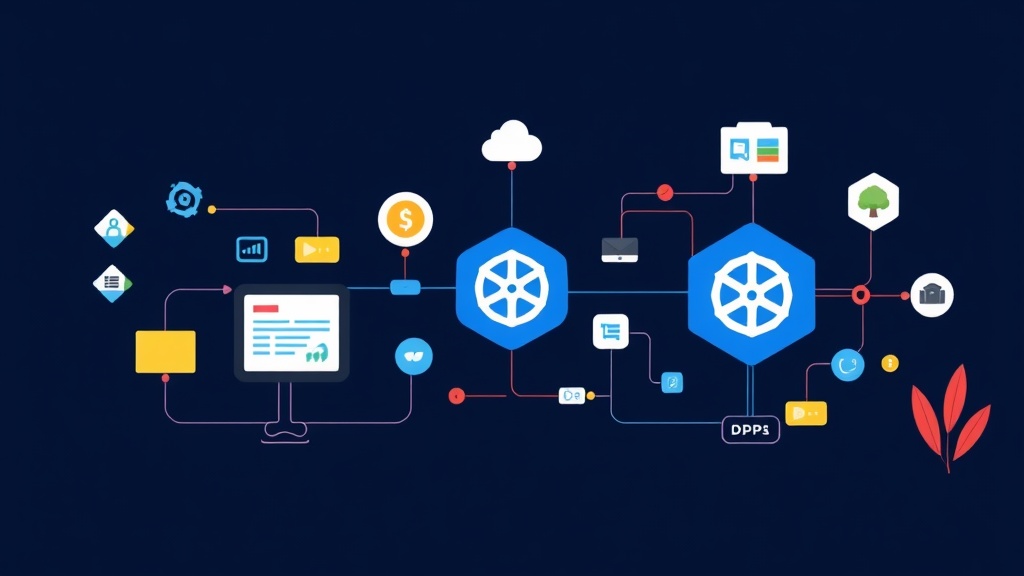
The core mechanism is the Sidecar Pattern. On Kubernetes, Dapr runs as a small container alongside your application in the same Pod. Your app hits localhost:3500, and the sidecar manages the networking, security, and retries. In my last production rollout, this approach reduced our boilerplate integration code by roughly 30%, allowing the team to ship features 2 days faster per sprint.
Key Building Blocks for This Guide
- State Management: A CRUD-style API to store and retrieve data without a DB driver.
- Publish and Subscribe (Pub/Sub): A standardized way to broadcast events between services while keeping them completely anonymous to each other.
Initializing Your Cluster
You’ll need a Kubernetes cluster (like Minikube) and the Dapr CLI. Start by initializing the Dapr control plane.
dapr init -kThis deploys the Dapr operator and sidecar injector into the dapr-system namespace. Run this command to ensure all five core services are healthy:
kubectl get pods -n dapr-systemImplementing State Management
Dapr uses a Component model. You define your database in a YAML file once, and your code never needs to know what it is. Let’s use Redis. Save this as statestore.yaml:
apiVersion: dapr.io/v1alpha1
kind: Component
metadata:
  name: my-statestore
spec:
  type: state.redis
  version: v1
  metadata:
  - name: redisHost
    value: redis-master.default.svc.cluster.local:6379
  - name: redisPassword
    secretKeyRef:
      name: redis
      key: redis-password
After applying this to Kubernetes, your app stores data with a simple POST request. No SDK required:
# Saving an order via HTTP
curl -X POST http://localhost:3500/v1.0/state/my-statestore \
     -H "Content-Type: application/json" \
     -d '[{"key": "order_99", "value": {"sku": "A100", "qty": 1}}]'
Swapping Redis for MongoDB later? Just update that YAML file. You won’t touch a single line of your Go, Python, or Node.js code.
Asynchronous Communication with Pub/Sub
Event-driven systems shouldn’t require complex broker configurations. In Dapr, we define a pubsub.yaml component to handle the messaging layer.
apiVersion: dapr.io/v1alpha1
kind: Component
metadata:
  name: my-pubsub
spec:
  type: pubsub.redis
  version: v1
  metadata:
  - name: redisHost
    value: redis-master.default.svc.cluster.local:6379
Firing an Event
To publish a message, your service hits its local sidecar. Here is what that look like in a standard shell command:
curl -X POST http://localhost:3500/v1.0/publish/my-pubsub/orders \
     -H "Content-Type: application/json" \
     -d '{"orderId": "99", "status": "paid"}'
Handling Subscriptions
Subscribing is even easier. Your app just tells Dapr what it wants by exposing a GET /dapr/subscribe endpoint. When a message hits the “orders” topic, Dapr will automatically deliver it to your /process-order route via a POST request.
// Your app's subscription config
[
  {
    "pubsubname": "my-pubsub",
    "topic": "orders",
    "route": "/process-order"
  }
]
Kubernetes Deployment
To wire this up, add three specific annotations to your deployment. This tells Kubernetes to automatically inject the Dapr sidecar.
apiVersion: apps/v1
kind: Deployment
metadata:
  name: order-service
spec:
  template:
    metadata:
      annotations:
        dapr.io/enabled: "true"
        dapr.io/app-id: "order-processor"
        dapr.io/app-port: "8080"
    spec:
      containers:
      - name: order-service
        image: myregistry/order-service:v1.2
The app-id is vital. It’s the unique identity Dapr uses for service-to-service discovery and mTLS security.
Standardizing Your Architecture
Moving to Dapr is a strategic shift. It’s about building portable applications that aren’t handcuffed to a specific cloud provider’s SDKs. In my experience, the initial setup time pays for itself the moment you need to scale or switch services. Start small by replacing your local state management. Once you see the sidecar in action, you can expand into Dapr’s Secrets Management or Distributed Tracing to get full visibility into your cluster out of the box.