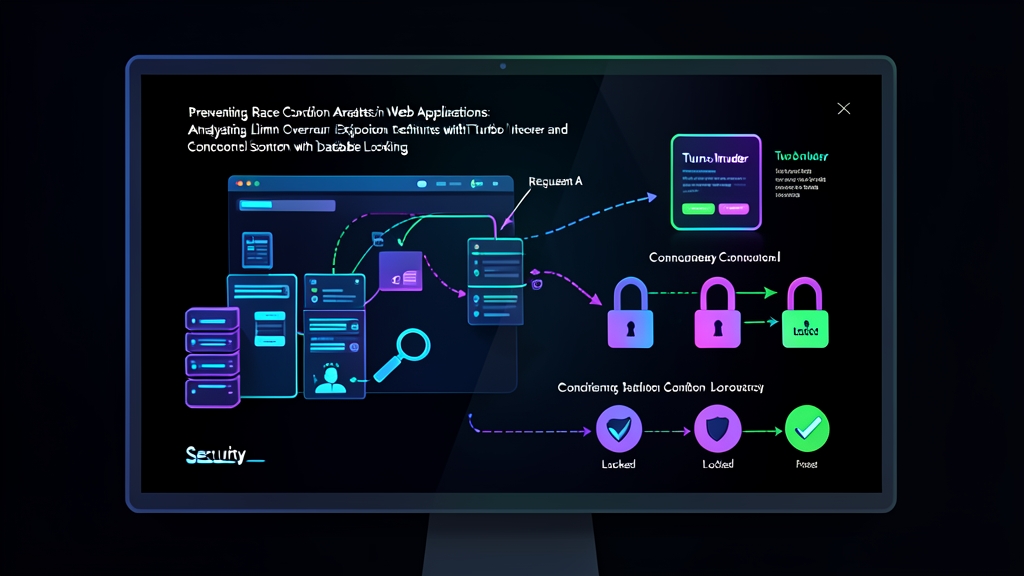
The Real-World Problem: The Coupon That Cleared Our Inventory
Last quarter, our team launched a promotion giving verified developers a single-use $50 compute voucher. We configured standard IP rate limits (5 requests per second), verified API bearer tokens, and wrote unit tests confirming that duplicate redemptions returned HTTP 400. Staging tests passed without a hitch.
Two hours after launch, Datadog fired an alert. A single account had redeemed the exact same voucher code 14 times within a 35-millisecond window. That single user pocketed $700 in compute credits. Our Nginx and application logs revealed 14 concurrent POST requests from the same IP address hitting /api/v1/coupons/redeem simultaneously. Every worker thread read the database, verified that is_used was still False, credited the account balance, and only then wrote is_used = True back to disk.
We had been hit by a limit overrun race condition. Attackers regularly hunt for these multi-step workflows. Common targets include balance transfers, promo codes, e-commerce checkouts, and upvote counters. Anywhere state verification and state modification sit across two separate queries, a window of vulnerability opens.
Root Cause Analysis: Time-of-Check to Time-of-Use (TOCTOU)
The technical culprit was a Time-of-Check to Time-of-Use (TOCTOU) bug. On modern multi-core servers, app servers like Gunicorn or Puma handle incoming requests using connection pools and worker pools. When two requests land within microseconds of each other, their execution flows interleave.
The Vulnerable Execution Flow
Here is a simplified version of our original Python backend handler:
def redeem_voucher(user_id, voucher_code):
    # 1. TIME OF CHECK
    voucher = db.query(Voucher).filter_by(code=voucher_code, is_used=False).first()
    if not voucher:
        return {"error": "Voucher invalid or already used"}, 400

    # 2. BUSINESS LOGIC (Latency window: ~12-25ms)
    account = db.query(Account).filter_by(user_id=user_id).first()
    account.balance += voucher.amount

    # 3. TIME OF USE
    voucher.is_used = True
    db.commit()
    return {"success": True, "balance": account.balance}, 200
Look at the gap between step 1 and step 3. Querying the account balance and running validation takes roughly 15 milliseconds. If Request A and Request B land within that 15-millisecond window, both run step 1 before either reaches step 3. Both queries find an active voucher. Both credit the account. Both commit. Our single-use business rule disappears entirely.
How Attackers Exploit Concurrency: Turbo Intruder
Historically, network latency made timing these concurrent hits tricky. Packets scattered over the public internet often arrived with tens of milliseconds of jitter. Modern exploitation tools like Turbo Intruder (a Jython-based Burp Suite extension) eliminate this network jitter using the single-packet attack technique.
Rather than opening 20 individual TCP streams, Turbo Intruder pre-warms a single HTTP/2 connection. It prepares 20 to 30 complete HTTP redemption requests, holding back only the final byte of each payload. It then drops all remaining bytes into a single TCP packet. The web server receives the entire cluster in the exact same physical clock cycle, handing them off to internal threads in parallel.
Here is an audit script security engineers use to test endpoints for concurrency bugs:
def queueRequests(target, wordlists):
    engine = RequestEngine(endpoint=target.endpoint,
                           concurrentConnections=1,
                           engine=Engine.BURP2,
                           pipeline=False
                           )

    # Stage 20 identical requests without the final byte
    for i in range(20):
        engine.queue(target.req, gate='race1')

    # Release every request in a single TCP packet
    engine.openGate('race1')

def handleResponse(req, interesting):
    table.add(req)
If two or more requests come back with an HTTP 200 and increment the balance, your endpoint has a race condition.
Comparing Concurrency Control Solutions
We reviewed four technical options to patch the vulnerability across our architecture.
1. Application-Level Mutexes and In-Memory Locks
Developers often reach for language primitives like Python’s threading.Lock() or Go’s sync.Mutex. This stops races in a local test suite with one process. In production, it breaks immediately. Production systems run on multiple Kubernetes pods or multi-worker WSGI processes. A lock inside Worker 1 on Pod A cannot coordinate with Worker 3 on Pod B.
2. Distributed Locks with Redis (Redlock)
A second common pattern delegates lock synchronization to Redis. Before executing the transaction, the thread grabs a key such as lock:voucher:CODE123 with a short time-to-live (TTL):
# Acquire a Redis lock with a 3-second TTL
lock = redis_client.lock("lock:voucher:" + voucher_code, timeout=3)
if lock.acquire(blocking=False):
    try:
        # Execute transaction
        process_redemption(user_id, voucher_code)
    finally:
        lock.release()
else:
    return {"error": "Request already in progress"}, 429
This works across multiple pods, but it introduces operational headaches. Redis network partitions, node failovers, or long garbage collection pauses can cause the TTL to expire before the database write finishes. Once the lock drops early, the race condition returns. You now have two distributed systems to keep in sync for a problem that belongs in the database.
3. Optimistic Concurrency Control (Version Columns)
Optimistic locking fits workflows where concurrent collisions happen rarely. You place a version integer on the table and check it on every write:
UPDATE vouchers
SET is_used = TRUE, version = version + 1
WHERE id = 42 AND version = 1;
If another thread beat you to the write, zero rows update. Your application detects the zero-row count and aborts or retries. During high-demand flash sales or viral drops, however, thousands of requests will conflict at once. Repeated rollbacks and retries quickly chew through database CPU and I/O limits.
4. Database-Level Pessimistic Locking
Pessimistic locking delegates synchronization directly to PostgreSQL or MySQL. By running a SELECT ... FOR UPDATE query inside an explicit transaction, the engine locks the target row at the storage layer. Other transactions trying to inspect or modify that specific row must wait until the first transaction commits or rolls back.
The Recommended Fix: Pessimistic Row Locking and Atomic Mutations
For promo codes, financial balances, and inventory allocation, pessimistic row locking and atomic SQL operations offer the cleanest, most reliable protection without extra infrastructure.
Step-by-Step Implementation
To patch our redemption flow, we updated our SQLAlchemy code to request an exclusive row lock at the start of the transaction block:
from sqlalchemy.orm import Session

def redeem_voucher_secure(db: Session, user_id: int, voucher_code: str):
    try:
        with db.begin():
            # SELECT ... FOR UPDATE places an exclusive row lock on this voucher
            voucher = db.query(Voucher)\
                .filter_by(code=voucher_code)\
                .with_for_update()\
                .first()

            if not voucher or voucher.is_used:
                return {"error": "Voucher is invalid or already claimed"}, 400

            # Lock the account row to prevent balance write skew
            account = db.query(Account)\
                .filter_by(user_id=user_id)\
                .with_for_update()\
                .first()

            # Apply updates safely
            account.balance += voucher.amount
            voucher.is_used = True
            voucher.redeemed_by = user_id

        # Transaction auto-commits upon exiting the context block, releasing locks
        return {"success": True, "balance": account.balance}, 200

    except Exception:
        return {"error": "Internal server error"}, 500
Why This Neutralizes Single-Packet Attacks
When 20 synchronized requests arrive from Turbo Intruder, Thread 1 secures an exclusive lock on the voucher row. Threads 2 through 20 pause inside the database engine queue. Once Thread 1 marks is_used = True and commits, the lock passes to Thread 2. Thread 2 reads the refreshed row state, detects that is_used is already True, rejects the request, and exits. The remaining 18 threads do the same. Zero overruns.
Alternative: Single-Statement Atomic SQL Updates
If you prefer to avoid open transactions and row-lock waits entirely, a single atomic UPDATE ... WHERE query is even faster:
-- Atomic check-and-set query
UPDATE vouchers
SET is_used = TRUE, redeemed_by = 105
WHERE code = 'PROMO50' AND is_used = FALSE;

-- Inspect rows affected:
-- 1 row affected  -> Success. Credit account balance.
-- 0 rows affected -> Already redeemed. Reject immediately.
Relational databases guarantee row-level atomicity on writes. Only the first arriving query will match is_used = FALSE and return an affected row count of 1. All concurrent queries match 0 rows and abort immediately without queueing behind transaction locks.
Securing Supporting Infrastructure
Hardening application logic fixes the immediate bug, but broader security hygiene remains critical. When auditing our database accounts after this patch, we rotated every service and maintenance credential.
For staging and administrative access, generating strong server passwords through client-side tools like toolcraft.app/en/tools/security/password-generator keeps secrets contained in the browser without network exposure. Isolating database credentials ensures an application flaw cannot be chained into broader privilege escalation.
Takeaways for Your Next Code Review
- Watch for read-modify-write patterns: Any gap between querying a condition and writing the result is vulnerable to concurrent execution.
- Solve concurrency where the data lives: Before adding external lock coordinators like Redis, check if an atomic SQL update or
SELECT ... FOR UPDATEhandles it natively. - Test with single-packet tools: Add Turbo Intruder or custom concurrency scripts to your regular security pipeline to catch race conditions before production traffic does.