
Approach Comparison: Orchestrating Complex Asynchronous Logic
Managing asynchronous state across backend microservices or high-traffic browser sessions usually forces a choice between two patterns: Event-Driven Pub/Sub and the Actor Model.
Standard Pub/Sub architectures—such as Redis Pub/Sub, Apache Kafka, or Node.js EventEmitter—broadcast events to shared channels. Independent listeners consume messages at their own pace. This decoupling simplifies horizontal scaling, but it easily leads to state drift.
When five distributed listeners modify the same PostgreSQL record concurrently, race conditions follow. Error handling fragments across disparate callbacks. Reconstructing an entity’s exact lifecycle often demands aggregating logs across a dozen microservices.
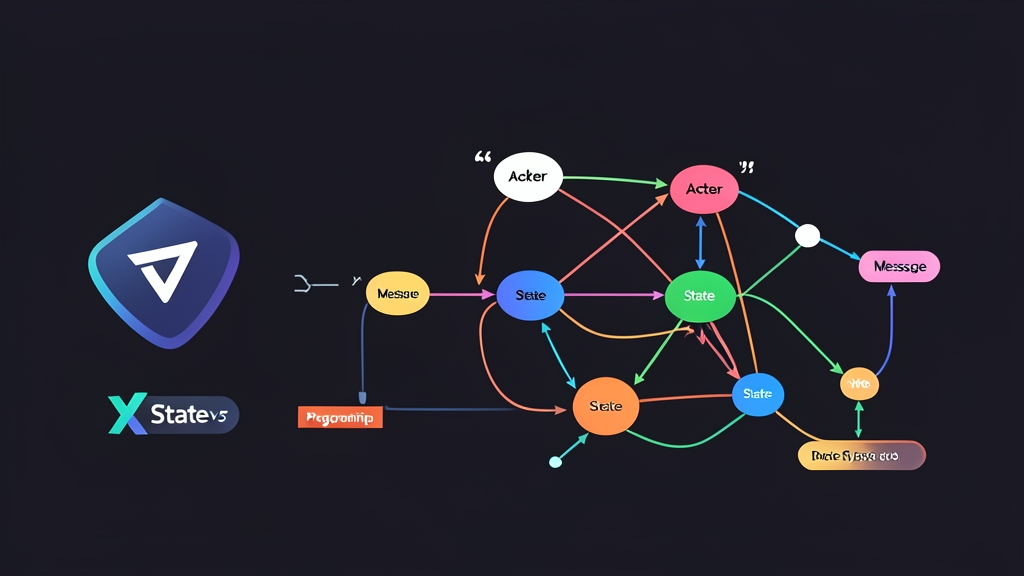
The Actor Model solves this by co-locating state, behavior, and a private message queue inside isolated units called actors. An actor mutates only its local state. It interacts with the outside world strictly through direct, asynchronous messages. XState v5 re-engineered its core primitives around this standard. State machines, promises, observables, and callbacks are now first-class actors. They can spawn, supervise, and exchange messages with child actors out of the box.
Pros & Cons of Using the Actor Model with XState v5
Adopting XState v5 as your actor runtime introduces clear architectural trade-offs worth evaluating before rewriting production pipelines.
Pros
- Zero In-Process Race Conditions: Each actor processes messages sequentially from its mailbox. You eliminate mutex locks, semaphores, and read-after-write conflicts during complex async operations.
- Hierarchical Supervision: Parent actors spawn dedicated children for isolated tasks like chunk uploads or socket heartbeats. If a child crashes, the supervisor can restart, throttle, or terminate it cleanly without bringing down the process.
- Compile-Time Type Safety: XState v5 leverages TypeScript’s template literal types and contextual typing. Event schemas, context properties, and child inputs type-check end-to-end without bloated boilerplate.
- Visual Traceability: Workflows remain declarative. You can export machines directly into the XState Stately visualizer to inspect edge cases or simulate failure paths before shipping to production.
Cons
- Steep Learning Curve: Shifting from linear
async/awaitimperative scripts to message-driven mailboxes takes practice. Teams must learn to think in event streams and state transitions. - Memory Footprint: An XState actor instance consumes roughly 2.5 KB to 5 KB of heap memory. While running 10,000 concurrent actors takes only ~35 MB of RAM, scaling to 1,000,000 persistent actors in a single Node.js runtime requires memory profiling. Plain async closures use less overhead.
- Persistence Overhead: Long-lived workflows spanning server restarts require custom persistence adapters. You must snapshot actor context to storage like Redis or DynamoDB and rehydrate state on boot.
Recommended Setup: Project Initialization and Architecture
When scaling beyond simple CRUD operations to ingest thousands of events per second, circular imports between supervisors and child actors can quickly stall development. Separating machine definitions into distinct modules prevents coupling.
Initialize a modern TypeScript project with strict ESM support:
mkdir xstate-actor-pipeline
cd xstate-actor-pipeline
npm init -y
npm install xstate@^5.18.0
npm install -D typescript @types/node tsx
npx tsc --init
Configure tsconfig.json to enforce modern module resolution and strict safety checks:
{
  "compilerOptions": {
    "target": "ES2022",
    "module": "NodeNext",
    "moduleResolution": "NodeNext",
    "strict": true,
    "esModuleInterop": true,
    "skipLibCheck": true
  }
}
Implementation Guide: Building a Resilient Data Ingestion Pipeline
The following example builds a resilient ingestion pipeline. A root pipelineSupervisor coordinates batch processing by enforcing a concurrency cap of two simultaneous workers, delegating chunks to child dataWorker actors.
1. Define the Worker Actor
The worker handles single-batch ingestion. It simulates network I/O with a 20% transient failure rate, manages its own retries up to three attempts, and reports outcomes back to the supervisor.
import { setup, fromPromise, sendParent, assign } from 'xstate';

export interface WorkerInput {
  batchId: string;
  items: string[];
}

export type WorkerEvents =
  | { type: 'PROCESS' }
  | { type: 'RETRY' };

const uploadBatchLogic = fromPromise(async ({ input }: { input: { batchId: string; items: string[] } }) => {
  // Simulate network I/O with a 20% transient failure rate
  if (Math.random() < 0.2) {
    throw new Error(`Transient network glitch on batch: ${input.batchId}`);
  }
  return { batchId: input.batchId, processedCount: input.items.length };
});

export const workerMachine = setup({
  types: {
    context: {} as { batchId: string; items: string[]; attempts: number },
    input: {} as WorkerInput,
    events: {} as WorkerEvents,
  },
  actors: {
    uploadBatch: uploadBatchLogic,
  },
}).createMachine({
  id: 'dataWorker',
  initial: 'idle',
  context: ({ input }) => ({
    batchId: input.batchId,
    items: input.items,
    attempts: 0,
  }),
  states: {
    idle: {
      on: {
        PROCESS: 'processing',
      },
    },
    processing: {
      entry: assign({
        attempts: ({ context }) => context.attempts + 1,
      }),
      invoke: {
        id: 'uploadTask',
        src: 'uploadBatch',
        input: ({ context }) => ({ batchId: context.batchId, items: context.items }),
        onDone: {
          target: 'completed',
          actions: sendParent(({ event }) => ({
            type: 'WORKER_SUCCESS',
            batchId: event.output.batchId,
            processedCount: event.output.processedCount,
          })),
        },
        onError: {
          target: 'failed',
        },
      },
    },
    failed: {
      always: [
        {
          guard: ({ context }) => context.attempts < 3,
          target: 'processing',
        },
        {
          target: 'aborted',
          actions: sendParent(({ context }) => ({
            type: 'WORKER_FAILED',
            batchId: context.batchId,
          })),
        },
      ],
    },
    completed: { type: 'final' },
    aborted: { type: 'final' },
  },
});
2. Implement the Supervisor Actor
The supervisor manages the queue. It spawns workers on demand while capping concurrent active workers at two, updating its internal registry as workers finish or fail.
import { setup, createActor, assign, type ActorRefFrom } from 'xstate';
import { workerMachine } from './worker.js';

type WorkerRef = ActorRefFrom<typeof workerMachine>;

interface SupervisorContext {
  queue: Array<{ batchId: string; items: string[] }>;
  activeWorkers: Record<string, WorkerRef>;
  completedBatches: string[];
  failedBatches: string[];
}

type SupervisorEvents =
  | { type: 'QUEUE_BATCH'; batchId: string; items: string[] }
  | { type: 'WORKER_SUCCESS'; batchId: string; processedCount: number }
  | { type: 'WORKER_FAILED'; batchId: string };

const MAX_CONCURRENT_WORKERS = 2;

export const supervisorMachine = setup({
  types: {
    context: {} as SupervisorContext,
    events: {} as SupervisorEvents,
  },
  actions: {
    spawnNextWorker: assign(({ context, spawn }) => {
      const activeCount = Object.keys(context.activeWorkers).length;
      if (activeCount >= MAX_CONCURRENT_WORKERS || context.queue.length === 0) {
        return {};
      }

      const [nextBatch, ...remainingQueue] = context.queue;
      const child = spawn(workerMachine, {
        id: `worker-${nextBatch.batchId}`,
        input: nextBatch,
      });

      child.send({ type: 'PROCESS' });

      return {
        queue: remainingQueue,
        activeWorkers: {
          ...context.activeWorkers,
          [nextBatch.batchId]: child,
        },
      };
    }),
  },
}).createMachine({
  id: 'supervisor',
  initial: 'active',
  context: {
    queue: [],
    activeWorkers: {},
    completedBatches: [],
    failedBatches: [],
  },
  states: {
    active: {
      on: {
        QUEUE_BATCH: {
          actions: [
            assign({
              queue: ({ context, event }) => [
                ...context.queue,
                { batchId: event.batchId, items: event.items },
              ],
            }),
            'spawnNextWorker',
          ],
        },
        WORKER_SUCCESS: {
          actions: [
            assign({
              completedBatches: ({ context, event }) => [
                ...context.completedBatches,
                event.batchId,
              ],
              activeWorkers: ({ context, event }) => {
                const updated = { ...context.activeWorkers };
                delete updated[event.batchId];
                return updated;
              },
            }),
            'spawnNextWorker',
          ],
        },
        WORKER_FAILED: {
          actions: [
            assign({
              failedBatches: ({ context, event }) => [
                ...context.failedBatches,
                event.batchId,
              ],
              activeWorkers: ({ context, event }) => {
                const updated = { ...context.activeWorkers };
                delete updated[event.batchId];
                return updated;
              },
            }),
            'spawnNextWorker',
          ],
        },
      },
    },
  },
});
3. Run and Monitor the System
Spin up the root supervisor actor and dispatch four test payloads:
import { createActor } from 'xstate';
import { supervisorMachine } from './supervisor.js';

const supervisor = createActor(supervisorMachine);

supervisor.subscribe((snapshot) => {
  const { activeWorkers, completedBatches, failedBatches, queue } = snapshot.context;
  console.log(
    `[Status] Active: ${Object.keys(activeWorkers).length} | ` +
    `Queued: ${queue.length} | ` +
    `Done: ${completedBatches.length} | ` +
    `Failed: ${failedBatches.length}`
  );
});

supervisor.start();

supervisor.send({ type: 'QUEUE_BATCH', batchId: 'b-101', items: ['payloadA', 'payloadB'] });
supervisor.send({ type: 'QUEUE_BATCH', batchId: 'b-102', items: ['payloadC'] });
supervisor.send({ type: 'QUEUE_BATCH', batchId: 'b-103', items: ['payloadD', 'payloadE'] });
supervisor.send({ type: 'QUEUE_BATCH', batchId: 'b-104', items: ['payloadF'] });
Watch the console output. Notice how the supervisor strictly adheres to the concurrency ceiling. Batches b-101 and b-102 spin up immediately, while b-103 and b-104 wait in the queue. Each worker handles its own network failures locally. When a worker completes, the supervisor drains the queue automatically—all without a single mutex or global variable.