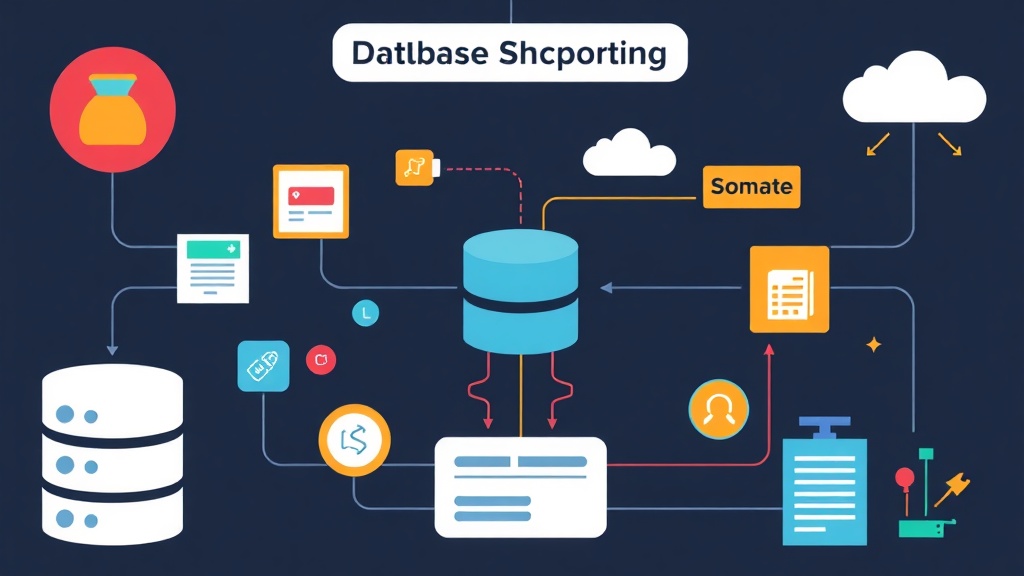
The Inevitable Wall: When Your Database Can’t Keep Up
It’s a familiar scenario for many of us in the IT world: an application launches, gains traction, and then suddenly, the database starts groaning under the weight of success. What began as snappy performance degrades into slow queries, timeouts, and frustrated users.
I’ve been there, watching a once-responsive system buckle as the user base swelled from thousands to millions, or as data accumulated into dozens of terabytes. The symptoms are unmistakable: high latency, unresponsive dashboards, and the constant threat of downtime.
For a while, we can often alleviate these issues by throwing more resources at the problem – upgrading servers with faster CPUs, more RAM, and NVMe drives. This is vertical scaling, and it’s a valid first step. But there comes a point where even the most powerful single server hits its limits, or the cost of further upgrades becomes prohibitive. That’s the wall I’m talking about, and it’s where we start looking for more fundamental solutions.
Understanding the Bottleneck: Why Scale Becomes a Challenge
To really tackle performance issues, it helps to understand why a single database server eventually struggles. The core issue lies in its limited physical resources. A single machine has finite CPU cores to process queries, a finite amount of RAM to cache data, and crucially, finite disk I/O bandwidth.
For instance, a powerful server might offer 64 CPU cores, 512GB of RAM, and top-tier NVMe throughput of around 1 million IOPS, but even these impressive specs have a ceiling. As data volume grows, the database engine has to sift through more information, leading to more disk reads and writes. As concurrent users increase, more queries hit the database simultaneously, contending for these limited resources.
Additionally, ensuring data consistency (ACID properties) across a massive dataset on a single server, especially during high write loads, can introduce significant overhead. Locks, transaction management, and indexing all consume valuable resources. At some point, these internal mechanisms, essential for data integrity, become part of the problem when pushed to extremes.
Navigating Scaling Strategies: A Comparison
Before diving into the specifics of sharding, it’s useful to understand the landscape of database scaling. I’ve explored various paths to tackle these challenges over the years.
Replication: The First Line of Defense
Replication, often a master-replica or leader-follower setup, is typically the first strategy employed. It involves maintaining multiple copies of your database. The master handles all write operations and then asynchronously or synchronously replicates those changes to one or more replicas. Reads can then be distributed across these replicas.
It’s a fantastic solution for scaling read-heavy applications and significantly improving high availability and disaster recovery. If the master fails, a replica can be promoted. However, for write-intensive applications, replication only goes so far. All writes still funnel through the single master, making it a persistent bottleneck.
Vertical Scaling: More Power, Temporary Relief
As mentioned, vertical scaling is about making your existing server more powerful. Upgrading hardware is straightforward and often doesn’t require application code changes. It can provide substantial performance boosts initially.
However, there are hard limits to how much you can scale vertically. Processor speeds don’t increase infinitely, and RAM/disk I/O capabilities eventually plateau. The cost also becomes astronomical for incremental gains. Ultimately, it buys you time but doesn’t fundamentally change the architecture for truly massive scale.
Introducing Sharding: The Horizontal Scaling Game-Changer
This brings us to horizontal scaling, or sharding. Instead of upgrading a single machine, sharding distributes your data across multiple, independent database instances—each running on its own server. This approach completely changes the game. It allows you to scale out almost indefinitely, adding more servers as your data and traffic grow. It’s a powerful concept, but it introduces its own set of complexities that require careful consideration.
Database Sharding: My Approach to Handling Massive Datasets
Having worked with MySQL, PostgreSQL, and MongoDB across different projects, each has its own strengths, and I’ve seen how different scaling challenges emerge with each. While MySQL and PostgreSQL are robust relational databases, implementing sharding often requires external tools or careful application-level design.
MongoDB, on the other hand, was built from the ground up with horizontal scaling via sharding as a core feature, making the operational overhead somewhat less daunting. Regardless of the database, the principles of sharding remain consistent.
What Exactly is Sharding?
Think of sharding like taking a single, massive encyclopedia and breaking it down into several smaller, independent volumes. Each volume (a ‘shard’) contains a subset of the total information, and each can be stored on a different shelf (server). When you need to find information, you first figure out which volume it’s in, and then go directly to that volume.
In database terms, a shard is a complete, independent database instance. It contains a subset of your data. The key to sharding is the ‘shard key’—a column or field whose value determines which shard a particular piece of data resides on. This key is critical for efficiently routing queries to the correct shard.
Key Sharding Strategies and Their Implications
Choosing a sharding strategy is one of the most important decisions, as it directly impacts data distribution, query performance, and future operational ease.
Range-Based Sharding
With range-based sharding, data is distributed based on a continuous range of values of the shard key. For example, user IDs from 1 to 1,000,000 might go to Shard A, while IDs from 1,000,001 to 2,000,000 go to Shard B.
Pros:
- Range queries are highly efficient, as all data within a range resides on a single shard.
- Data is logically grouped, which can be intuitive.
Cons:
- "Hot spots" can occur if data is not uniformly distributed or if specific ranges experience disproportionately high traffic (e.g., new users all get assigned to the same shard).
- Rebalancing can be complex if ranges need to be adjusted.
Here’s a conceptual SQL example:
-- Imagine your application logic determines the shard based on user_id
-- Query for users in a specific range, directed to Shard 1 (e.g., if it holds IDs 1 to 1,000,000)
SELECT * FROM users.shard1 WHERE user_id BETWEEN 500000 AND 500010;

-- Query for users in another range, directed to Shard 2 (e.g., if it holds IDs 1,000,001 to 2,000,000)
SELECT * FROM users.shard2 WHERE user_id BETWEEN 1500000 AND 1500010;
Hash-Based Sharding
Hash-based sharding distributes data by applying a hash function to the shard key. The output of the hash function determines the shard. This aims to achieve a more uniform distribution of data across shards.
Pros:
- Excellent for distributing data evenly and avoiding hot spots, as the hash function tends to scatter data.
Cons:
- Range queries become problematic. Logically sequential data may be scattered across many shards, requiring queries to be fanned out to all shards.
- Adding or removing shards can necessitate re-hashing and redistributing a significant amount of data.
A simple Python example for determining a shard:
import hashlib

def get_shard_id(key_value, num_shards):
    # Using a simple hash (MD5) and modulo for shard determination
    # In a real system, you might use more sophisticated consistent hashing
    return int(hashlib.md5(str(key_value).encode()).hexdigest(), 16) % num_shards

# Example usage for a user ID
user_id_to_store = 987654321
number_of_database_shards = 4
shard_index = get_shard_id(user_id_to_store, number_of_database_shards)
print(f"Data for user {user_id_to_store} should go to Shard {shard_index}")

# Another example
order_id_to_store = "ORDER-XYZ-789"
shard_index_order = get_shard_id(order_id_to_store, number_of_database_shards)
print(f"Data for order {order_id_to_store} should go to Shard {shard_index_order}")
Directory-Based Sharding
This approach uses a lookup table or service (often called a config server or router) that maps shard keys to specific shards. The application queries this directory first to find the correct shard for a piece of data.
Pros:
- Highly flexible: Shards can be added or removed, and data can be moved between shards without re-hashing all data.
- Allows for complex sharding logic and physical separation of data.
Cons:
- Adds an extra layer of complexity and an additional point of failure (the lookup service needs to be highly available).
- Lookup latency before reaching the actual data shard.
A conceptual JSON representation of a shard map:
// Shard Map Configuration (managed by a router/config server)
{
  "users_collection": {
    "shard_key": "username",
    "distribution_method": "hash",
    "shards": [
      {"range_start": "a", "range_end": "g", "server": "user_shard_01.example.com"},
      {"range_start": "h", "range_end": "n", "server": "user_shard_02.example.com"},
      {"range_start": "o", "range_end": "z", "server": "user_shard_03.example.com"}
    ]
  },
  "products_collection": {
    "shard_key": "product_id",
    "distribution_method": "range",
    "shards": [
      {"range_start": 1, "range_end": 1000000, "server": "product_shard_01.example.com"},
      {"range_start": 1000001, "range_end": 2000000, "server": "product_shard_02.example.com"}
    ]
  }
}
The Operational Realities: Challenges I’ve Encountered
While sharding offers immense power, it’s not a magic solution. The added complexity is significant, and I’ve certainly navigated some tricky situations:
- Shard Key Selection: This is arguably the most critical decision. A poor shard key can lead to uneven data distribution (hot spots), make certain queries extremely inefficient, or prevent future rebalancing. The shard key should be chosen carefully, ideally immutable, and evenly distributed.
- Data Rebalancing: As data grows or access patterns change, some shards might become overloaded. Rebalancing involves moving data from one shard to another, a non-trivial process that can be resource-intensive and potentially impact performance during the operation.
- Cross-Shard Queries: Queries that require joining or aggregating data from multiple shards are inherently complex and slower. The application or a dedicated query router needs to fan out the query to all relevant shards, collect results, and then merge them. This process can negate some of sharding’s performance benefits for specific query types.
- Distributed Transactions: Maintaining ACID properties for transactions that span multiple shards is extremely challenging. Often, developers resort to eventual consistency models or implement complex two-phase commit protocols, which add significant complexity and latency.
- Schema Changes: Applying schema migrations across a sharded cluster requires careful orchestration to ensure consistency across all shards without downtime.
- Operational Complexity: Monitoring, backups, and disaster recovery become more involved with a distributed system. You’re now managing a cluster of databases rather than a single instance.
When to Choose Sharding: A Practical Outlook
Sharding is a technique I consider when all other scaling options have been exhausted, or when anticipating truly massive, sustained growth. It’s not usually the first choice due to its inherent complexity.
- When vertical scaling is no longer economically or technically feasible.
- When your application consistently handles millions (or billions) of records and continues to grow.
- When read and, more importantly, write operations consistently push single-node performance beyond its limits.
- When you need to distribute data globally for lower latency for geographically dispersed users.
Many NoSQL databases, like MongoDB, are designed with sharding in mind. Their architecture inherently supports data distribution, often simplifying the setup and management compared to manually sharding a relational database. For relational databases, solutions like CitusData for PostgreSQL or Vitess for MySQL provide sharded architectures, abstracting some of the complexity, but they still require a deep understanding of distributed systems.
Final Thoughts on Scaling for Growth
Database sharding is a powerful technique for achieving horizontal scalability, allowing systems to handle immense data volumes and high transaction rates. It’s a testament to the ingenuity in database engineering, providing a path forward when vertical scaling hits its ceiling.
However, it’s a significant architectural commitment that introduces a new layer of complexity to system design and operations. My experience tells me this: while the rewards of successful sharding are immense in terms of performance and resilience, careful upfront planning, shard key selection, and ongoing operational vigilance are crucial for making it a success. It’s a strategic investment in the long-term scalability of your application.